
Chicken Coop Temperature Sensors: An Effective Way to Prevent Heat Stress in Broilers Before It Affects Production

There’s a familiar sight for anyone who’s ever stepped into a broiler coop on a scorching midday: chickens huddled in the corners of the coop, their wings spread slightly away from their bodies, panting with their beaks open, and feeding with far less enthusiasm than usual. Many farmers consider this a “normal” occurrence that will resolve on its own once the weather cools down. In reality, behind this scene, the chickens are experiencing heat stress—and every hour that passes under these conditions means a continuously accumulating loss in productivity.
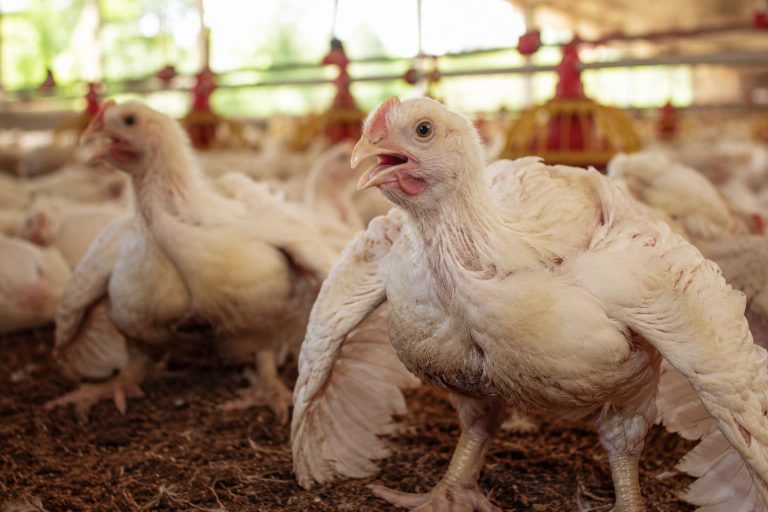
The problem is, heat stress isn’t always as obvious as the scenario described above. Sometimes it manifests in subtler ways: feed intake gradually decreasing over several days, slowed weight gain without a clear cause, or a slight increase in mortality without any obvious signs of disease. In such situations, farmers are often at a loss to identify the cause, even though the answer lies in a single variable that can actually be monitored with precision: the temperature and humidity inside the coop.
This article will specifically discuss why temperature is the most critical variable in broiler management, how heat stress occurs and impacts chicken performance, and how IoT-based chicken house temperature sensors are changing the way farmers detect and respond to these conditions before losses actually occur.
Why Temperature Is the Most Sensitive Variable in Broiler Management
Broiler chickens, unlike many other farm animals, have relatively limited thermoregulatory capabilities, especially during the early stages of their lives. Day-old chicks (DOCs) are not yet able to optimally regulate their own body temperature during the first week, making them highly dependent on the environmental temperature of the house provided by the farmer.
When the house temperature falls outside the chickens’ comfort zone, their bodies automatically divert some of their metabolic energy toward regulating body temperature rather than toward muscle growth or weight gain. In excessively hot conditions, chickens increase their respiratory rate (panting) as a cooling mechanism, while simultaneously reducing feed intake because the digestive process generates additional heat that the body does not need under such conditions. On the other hand, water intake actually increases sharply as a compensatory measure.
This combination of reduced feed intake and increased water intake creates a situation that is detrimental in two ways simultaneously: growth slows due to reduced nutrient intake, while the FCR worsens because the ratio of feed to body weight produced becomes disproportionate. Research published on ResearchGate regarding an IoT-based temperature and humidity monitoring system in broiler chicken houses confirms that unstable house temperatures are one of the main causes of suboptimal productivity in the field.
Ideal Temperature Zones by Age: An Often-Overlooked Target
One common mistake in the field is setting a single “safe” house temperature for the entire rearing period, even though chickens’ temperature needs change significantly with age. The following are ideal temperature zones that serve as general guidelines:

During the DOC phase (from day one through day seven) chicks require a relatively high housing temperature, around 32 to 34 degrees Celsius, because their ability to regulate body temperature is still very limited. From day eight through day fourteen, the ideal temperature is gradually lowered to 29 to 32 degrees Celsius, as the chicks’ feathers begin to grow and their ability to regulate body temperature improves slightly. From the fifteenth to the twenty-first day, the temperature is lowered again to the range of 26 to 29 degrees Celsius. And from the twenty-second day onward, the ideal temperature ranges from 21 to 24 degrees Celsius, since chicks at this stage have a more complete feather coat and greater body mass, resulting in increased internal body heat production.

The problem is that these target temperature shifts are often not consistently followed in the field, especially in houses that still rely on manual adjustments—such as opening and closing curtains or turning on heaters based on the operator’s visual estimates. A delay in adjustment of just one or two days is enough to create a period of stress that impacts the overall performance of the cycle.
The Impact of Humidity, Often Overlooked in Discussions of Temperature
Discussions about house temperature often dominate poultry farmers’ attention, while relative humidity receives far less attention—even though its impact is no less significant. The ideal humidity for optimal broiler growth ranges from 50 to 70%.
When humidity is too low—below this threshold—the air in the house becomes dry and dusty, which can irritate the chickens’ respiratory tracts and accelerate dehydration of the litter, thereby reducing litter quality and creating excessive dust. Conversely, when humidity is too high (above 80%) the litter becomes wet and damp, creating ideal conditions for bacterial growth and ammonia buildup, while also making the chickens feel “hotter” than the actual temperature because their bodies’ ability to dissipate heat through evaporation is impaired. This is why a combination of high temperature and high humidity is far more dangerous than high temperature with well-controlled humidity.
This phenomenon explains why two houses with the same temperature can exhibit vastly different levels of heat stress in their chickens—the difference lies in the humidity accompanying that temperature. Accurate and continuous humidity monitoring is an indispensable complement to temperature monitoring.
Why Manual Checks Often Fail to Detect Actual Temperature Patterns
Many poultry houses still rely on conventional wall-mounted thermometers that are checked several times a day by house operators. This approach has three fundamental shortcomings that are difficult to overcome without supporting technology.
First, manual checks capture conditions only at a specific moment, not trends over the day. The house temperature can spike sharply at 1:00 p.m. when no one is monitoring it, then return to normal by 3:00 p.m. when the operator arrives to check. So that temperature spike is never recorded at all, even though its impact on the chickens has already occurred.
Second, a single measurement point does not represent the entire house. Broiler houses, especially long ones, often have significant temperature variations between zones. Areas near the entrance are usually cooler due to better air circulation, while the middle or rear of the house can be much hotter due to the accumulation of body heat from the chickens and minimal air movement. A single thermometer, typically installed at just one point, will not detect these variations.
Third, the response to abnormal temperatures depends on the physical presence of humans. If the temperature spikes in the middle of the night and no operator is on duty at the site, no corrective action will be taken until morning and during that time, the chickens will have already experienced prolonged stress, the effects of which cannot be fully reversed.
How IoT Temperature and Humidity Sensors Address These Three Shortcomings
IoT-based chicken coop temperature sensor systems are specifically designed to systematically address the three shortcomings mentioned above. Instead of a single measurement point checked several times a day, IoT sensors continuously collect data (typically every few minutes) from various points strategically placed throughout the coop.
Placing sensors at a minimum of three points (the front, middle, and back of the coop) allows farmers to detect zone-specific variations that were previously invisible with a single thermometer. If it is found that the rear zone is consistently 3–4 degrees hotter than the front zone, this is a clear signal that there is a problem with ventilation distribution that needs to be corrected, rather than merely a random fluctuation that can be ignored.

What truly revolutionizes the way farmers work is the system’s automatic alert capability. As soon as the temperature strays outside the comfort zone based on the age of the chickens being raised, the system immediately sends a notification to the farmer’s smartphone, complete with information on which sensor detected the anomaly. In systems already integrated with coop equipment such as exhaust fans, farmers can even activate the fans remotely without having to be physically present at the coop (a capability that is particularly valuable when anomalies occur during hours outside of direct supervision), such as in the middle of the night or early morning.
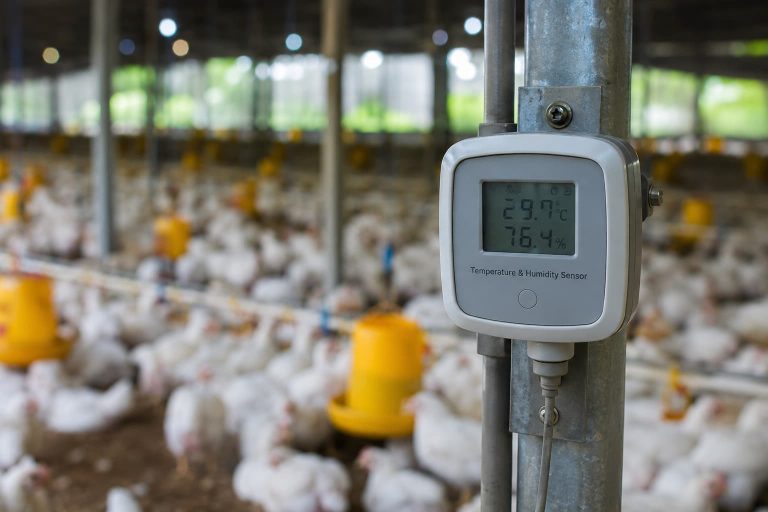
Research published in MALCOM: Indonesian Journal of Machine Learning and Computer Science in 2025 specifically confirmed that Internet of Things (IoT)-based automation of temperature and humidity control in broiler chicken coops has a significant impact on productivity compared to manual control. These findings align with practical experience: the faster the response to temperature anomalies, the shorter the duration of stress experienced by the chickens, and the smaller the impact on growth and feed efficiency.
Practical Implementation: How to Place and Configure Sensors in Your Poultry House
For poultry farmers who are just beginning to consider investing in temperature and humidity sensors, there are several practical principles to keep in mind to ensure that the monitoring results are truly representative.

Sensor placement should take into account the airflow patterns in the poultry house, rather than simply spacing them evenly. In houses with tunnel ventilation systems, for example, the fresh air intake is typically cooler than the exhaust at the far end of the house, so placing sensors at both ends will provide the most informative picture of temperature variations. Sensor mounting height is also important (ideally), it should be adjusted to the height of the chickens, rather than mounted too high near the roof, where temperatures tend to be hotter due to direct solar radiation on the roof.

Alert parameter configurations also need to be adjusted according to the chickens’ current growth phase, rather than using a single fixed threshold for the entire cycle. A good system allows farmers to schedule automatic changes to temperature targets based on the chickens’ age, ensuring that the alerts sent are truly relevant to the chickens’ needs on that particular day—not generic thresholds that can result in too many false notifications or, conversely, fail to detect genuinely dangerous conditions.

After several cycles, the collected historical temperature and humidity data can be analyzed to identify seasonal patterns. Many poultry houses in Indonesia face different challenges between the dry season (when daytime temperatures can be extremely high) and the rainy season (when high humidity becomes the primary concern). Understanding these patterns helps farmers develop more season-specific mitigation strategies, rather than relying on the same generic approach year-round.

Case Study: A Poultry House with a Hidden Hot Spot in the Rear Section
A 5,000 bird broiler house in Central Java experienced a puzzling pattern over several cycles: chickens in the rear section of the house consistently had lower slaughter weights than those in the front, even though they received the same feed and water. The farmer initially suspected this was due to uneven feed distribution, but after further investigation (including the installation of temperature sensors at three points) it was found that the temperature at the back of the house was consistently 3.5 degrees higher than at the front, especially during the day.
The cause turned out to be the placement of the exhaust fan, which was installed on only one side of the coop, creating uneven airflow along the length of the coop. The rear section, being farther from the fan, experienced an accumulation of body heat from the chickens that was not effectively dissipated. Once this issue was identified, the farmer added an additional exhaust fan at the rear and adjusted the ventilation curtain settings.
In the next cycle, the variation in harvest weight between coop zones decreased significantly, and the overall average harvest weight for the entire coop increased because the rear section (which had previously lagged behind) now grew at the same rate as the front section. The lesson from this case is clear: problems rooted in uneven temperature distribution often go unnoticed until zone-specific data is actually collected and systematically compared.
FAQ: Questions About Temperature Sensors and Heat Stress in Broilers

What are the early signs of heat stress in broilers to watch out for? Common early signs include an increased respiratory rate (faster, labored breathing), chickens scattering and moving away from heat sources or huddling together, decreased feed intake followed by increased water consumption, and a general decrease in activity. If these signs appear together, the house temperature is likely already outside the chickens’ comfort zone.

What is the ideal humidity range for a broiler house? The ideal relative humidity ranges from 50 to 70%. Outside this range—whether it’s too dry or too humid—chickens are at risk of respiratory problems or deteriorating litter conditions, both of which negatively impact growth performance.

Can IoT temperature sensors detect temperature differences between zones within a single coop? Yes, in fact, this is one of the main advantages of IoT sensors over conventional thermometers. By placing several sensors at different points, farmers can view a more representative temperature map and identify hot spots or cold spots that would not be visible with a single measurement point.

Does heat stress only occur during the dry season? Not always. Heat stress can occur at any time if barn ventilation is insufficient to dissipate the chickens’ body heat, especially in high-density barns. During the rainy season, high humidity can actually exacerbate the heat stress experienced by chickens even if the actual air temperature isn’t extremely high.

How do temperature sensors help reduce poultry house operating costs? With real-time temperature data, farmers only activate fans or heaters when necessary based on actual conditions, rather than on a fixed schedule or estimates. This approach reduces energy waste while preventing losses caused by heat stress, which impacts FCR and harvest weight.

Conclusion: Managing the Invisible with Measurable Data
Heat stress in broiler chickens is one of the most common problems affecting poultry farmers, precisely because its effects are not always visually apparent until they have already occurred. IoT-based chicken coop temperature sensors shift this approach from reactive to proactive—farmers no longer have to wait until the chickens show obvious signs of stress but receive alerts as soon as temperatures begin to move into the danger zone.
Investing in temperature and humidity sensors isn’t just about the convenience of technology; it’s about safeguarding profit margins that have often been eroded by problems that are actually preventable. For farmers who want to ensure that every production cycle runs under consistently optimal environmental conditions, sensor-based monitoring systems like those developed by BAKU can serve as a concrete first step. If you’d like to learn more about how zone-by-zone temperature mapping can be applied in your own coop, please consult with a team that understands the operational context of Indonesian poultry farming.
List of References
  1. ResearchGate. (2024). An IoT-Based Temperature and Humidity Monitoring System for Broiler Chicken Coops to Improve Production. researchgate.net
  2. MALCOM: Indonesian Journal of Machine Learning and Computer Science. (2025). Internet of Things-Based Automation of Temperature and Humidity Control in Broiler Chicken Houses. journal.irpi.or.id
  3. Chickin.id. (2024). Standards and Methods for Calculating FCR in Broiler Chickens. chickin.id/blog
  4. De Heus Indonesia. (2024). How to Determine FCR for Broiler and Layer Chickens: A Complete Guide. deheus.id
  5. Proceedings of the SATI National Seminar. (2025). Design of an IoT System for Controlling Broiler Chicken House Temperature to Improve Productivity Using the Mamdani Fuzzy Method. ojs.unkriswina.ac.id
Scroll to top
× Whatssapp Us