
How to Increase Broiler Chicken FCR with IoT Technology: Complete Guide 2026
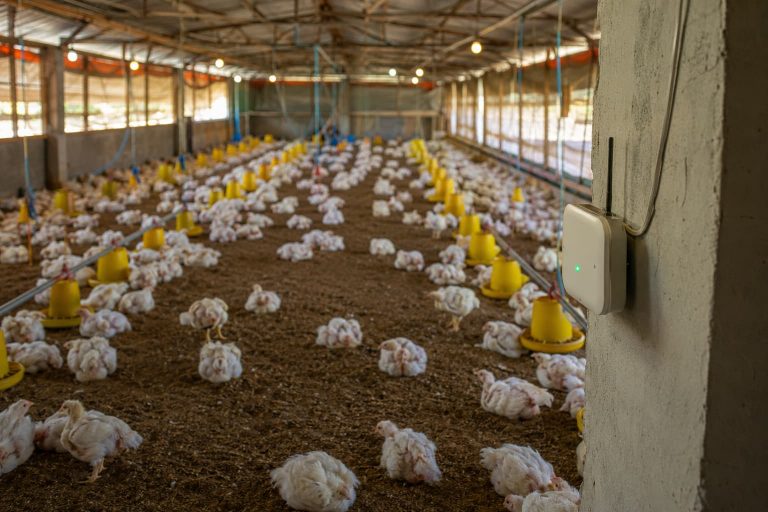
The Indonesian poultry industry continues to grow. According to data from the Ministry of Agriculture (Kementan), national purebred chicken (broiler) meat production reached 3.84 million tons in 2024, with an average growth of 4.51% per year from 2020 to 2024. The poultry sector even contributes 60% of the national livestock Gross Domestic Product (GDP) and creates employment for 10% of the national workforce.
Amidst this promising growth, there is one number that determines whether a farmer makes a profit or a loss: FCR, or Feed Conversion Ratio.
A poor FCR is a silent leak eroding a farmer’s profit margins every single day. This is where Internet of Things (IoT) technology comes in as a game-changer. This article covers comprehensively what FCR is, why this figure is so crucial, and how IoT monitoring can help Indonesian broiler chicken farmers achieve their best possible FCR.
What is Broiler Chicken FCR and Why Is It So Important?
FCR (Feed Conversion Ratio) is the ratio of feed amount (kg) required to produce 1 kg of broiler chicken meat. The simple formula is:- FCR = Total feed consumption (kg) / Total live weight of chicken produced (kg)
- Calculation Example:
- Total feed consumption from start to end of period: 7900 kg
- Total live chickens at harvest: 4000 birds
- Average body weight per chicken at harvest: 1.5 kg
- FCR =7900 / (4000 x 1.5) = 1.316
Broiler Chicken FCR Standards You Need to Know
- Age 14–21 days: Ideal FCR 1.31 (Ross strain) / 1.33 (Cobb strain)
- Age 28–35 days: Ideal FCR 1.45 (Ross strain) / 1.45 (Cobb strain)
- Generally good FCR: Ranges between 1.5 and 1.8
Factors Affecting Broiler Chicken FCR
Understanding the factors determining FCR is the first step toward improving it. There are five main factors:- Coop Temperature and Humidity
Coop temperature is the single variable that affects FCR most rapidly. When temperatures are outside the comfort zone, chickens expend feed energy for body temperature regulation rather than growth. This directly increases the FCR value.
Heat stress in broiler chickens causes reduced feed intake alongside increased water consumption. As a result, growth slows while FCR worsens. Studies from various Indonesian institutions confirm that unstable coop temperatures are a primary cause of suboptimal productivity.
Ideal temperature zones by age:- DOC (Day 1–7): 32–34°C
- Day 8–14: 29–32°C
- Day 15–21: 26–29°C
- Day 22 onwards: 21–24°C
- Feed Quality and Feeding Schedule
Low-quality feed with unbalanced nutritional content is directly reflected in a high FCR value. In addition to quality, an inconsistent feeding schedule also has a significant impact. Delays in feeding time, even by just one hour, can disrupt metabolic rhythms and reduce feed conversion efficiency.
- Stocking Density
Excessive stocking density creates competition for feed, increases ammonia levels, and worsens heat stress. All these conditions contribute to deteriorating FCR and higher mortality.
- Ammonia Levels
Studies show that closed coops without proper ventilation can reach ammonia levels up to 57.27 ppm, a lethal condition. High ammonia levels cause respiratory tract irritation, decrease appetite, and increase mortality—all of which significantly raise FCR.
- Genetics and DOC Quality
Genetic factors determine the maximum potential for feed efficiency. Day-Old Chicks (DOC) from superior strains such as Ross or Cobb have lower standard FCRs compared to local strains, but require more precise environmental management to reach their full potential.
How Does IoT Technology Help Improve FCR?
Manual monitoring has a fundamental limitation: farmers cannot monitor coop conditions 24 hours a day, 7 days a week. Temperature shifts in the middle of the night, ammonia spikes during ventilation failures, or humidity fluctuations during heavy rain can all go undetected until it is too late.
This is the gap filled by IoT coop monitoring systems. By placing sensors inside the coop and connecting them to a digital platform, farmers gain full, real-time visibility over coop conditions from anywhere, at any time.
- Research shows that IoT-based automated temperature and humidity control provides a significantly positive impact on broiler chicken productivity compared to manual control.
What Does an IoT Coop System Monitor?
Modern IoT coop systems such as those developed by BAKU monitor the following crucial parameters:- Coop temperature – Monitored per zone to detect cold and hot spots
- Relative humidity – Ideal humidity is 50–70% for optimal growth
- Ammonia levels ($NH_3$) – Automated alerts before reaching dangerous levels
- Ventilation and wind speed – To ensure optimal air circulation
- Water and feed consumption – Early indicators of stress and disease
From Data to Action: How IoT Transforms FCR
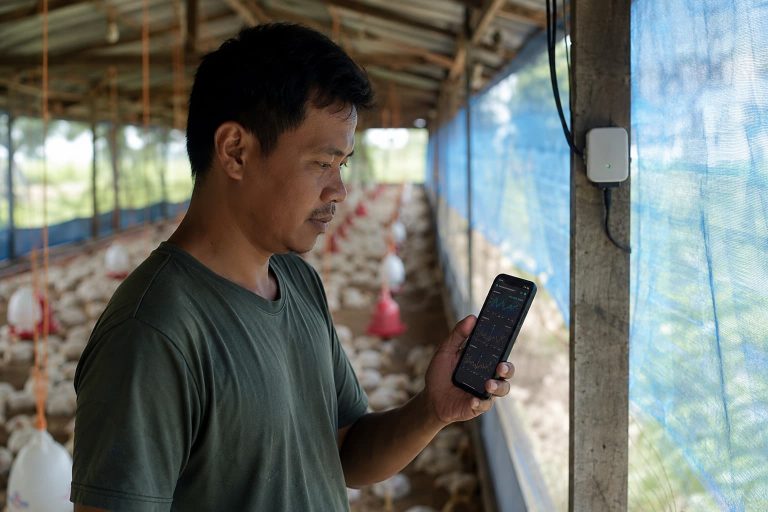
An IoT system doesn’t just collect data—it analyzes it and sends alerts directly to the farmer’s smartphone when any parameter drifts outside the optimal range. This means:- Temperature rises 2 degrees above comfort zone at midnight? An alert arrives within seconds, and fans can be activated remotely.
- Ammonia levels approach a critical threshold? Farmers receive notifications before chickens are exposed to hazardous conditions.
- Water consumption drops drastically all of a sudden? This serves as an early indicator of disease that can be handled immediately before spreading.
Practical Guide to FCR Optimization with IoT: Step-by-Step
- Step 1: Baseline and Initial Measurement
Calculate your coop’s actual FCR over the last 2–3 cycles before starting. This serves as a baseline to measure improvements. Also document coop conditions: strain type, density, ventilation system, and average daily temperature.
- Step 2: Install Sensors at Strategic Points
Place temperature and humidity sensors in at least 3 distinct locations inside the coop (front, middle, back) to detect zonal variations. Ammonia sensors should be installed at chicken head-level height for accurate measurement.
- Step 3: Set Alert ParametersConfigure the system to trigger alerts when:
- Temperature strays from the optimal zone based on chicken age
- Humidity goes above 80% or below 40%
- Ammonia exceeds 10 ppm (early warning) and 25 ppm (critical)
- Step 4: Analyze Historical Data Every Cycle
After each harvest cycle, review historical data to identify patterns: at what hours does temperature most frequently leave the ideal range? Is there a correlation between high-humidity days and reduced feed intake? This data forms the foundation for management improvements in subsequent cycles.
- Step 5: Benchmark FCR Every Cycle
Compare FCR across cycles and record any operational changes made. This builds an increasingly accurate decision-making database over time.
Case Study: Impact of Automated Monitoring on Coop Productivity
- More accurate and efficient temperature and humidity monitoring compared to manual methods
- Early detection capabilities for abnormal conditions before they escalate into production issues
- Significant increases in growth productivity compared to coops without automated monitoring
- Reduced mortality through rapid responses to changing environmental conditions
Conclusion: FCR Is Not Fate, It's a Choice
A good broiler chicken FCR isn’t merely a matter of luck or the genetic quality of DOCs alone. FCR is the result of a series of daily management decisions made inside the coop—and the quality of those decisions depends heavily on the quality of available information.
IoT coop monitoring technology gives farmers access to insights previously available only to large corporate farms: real-time data, automated alerts, and historical track records that enable continuous cycle-over-cycle improvement.
- Amid projections of increasing demand for animal protein in Indonesia—with the MBG (Free Nutritious Meal) program requiring an additional 1.1 million tons of chicken meat—farmers who invest in smart monitoring systems today are those ready for the next level of scale.
BAKU provides IoT coop monitoring solutions tailored specifically to the Indonesian farming context. From real-time sensors to data-driven analytical dashboards, BAKU helps broiler farmers across Indonesia optimize their FCR systematically and measurably.
References & Data Sources
- Directorate General of Livestock and Animal Health, Ministry of Agriculture (Kementan). (2024). Kementan Dorong Pelaku Usaha Perluas Ekspor Produk Unggas Nasional. ditjenpkh.pertanian.go.id
- National Food Agency (Bapanas). (2025). Produksi Telur dan Daging Ayam Surplus. Proyeksi Neraca Pangan per April 2025.
- Journal of Animal Science, UIN Sultan Syarif Kasim Riau. (2024). Evaluasi Usaha Ternak Ayam Broiler Sistem Kemitraan Inti Plasma Berbasis Index Performance (IP). ejournal.uin-suska.ac.id
- Agrosilvopasture-Tech Journal, Vol. 3 No. 1. (2024). Pertambahan Bobot Badan dan FCR Broiler Strain CP-707 pada Kemitraan PT. Mitra Sinar Jaya. ojs3.unpatti.ac.id
- MALCOM: Indonesian Journal of Machine Learning and Computer Science. (2025). Otomatisasi Pengendalian Suhu dan Kelembaban Berbasis Internet of Things pada Kandang Ayam Potong. journal.irpi.or.id
- ResearchGate. (2024). Sistem Monitoring Suhu dan Kelembapan pada Kandang Ayam Broiler Berbasis IoT untuk Meningkatkan Produksi. researchgate.net
- ResearchGate. (2021). Sistem Monitoring Kualitas Udara dan Otomatisasi Pemberian Pakan Ayam Berbasis IoT. researchgate.net
- SATI National Seminar Proceedings. (2025). Perancangan IoT Pengendalian Suhu Kandang Ayam Broiler untuk Peningkatan Produktivitas Menggunakan Metode Fuzzy Mamdani. ojs.unkriswina.ac.id
- Chickin.id. (2024). Standar dan Cara Menghitung FCR Ayam Broiler. chickin.id/blog
- Kompas.id. (2025). Indonesia Berpotensi Kekurangan Telur dan Daging Ayam pada 2026. kompas.id
- De Heus Indonesia. (2024). Cara Menentukan FCR untuk Ayam Broiler dan Layer: Panduan Lengkap. deheus.id